Zhangjiajie in Chinese: How to Write & Pronounce 张家界 (+ Survival Phrases)
Your taxi rolls up outside Zhangjiajie West Station. The driver hands you his phone. The navigation app is blank. You typed “Zhangjiajie” in English — he wants the three Chinese characters instead. You open your mouth, and realize you’ve never actually said it right.
That’s normal. I’ve met plenty of travelers here who turned “Zhangjiajie” into “Zang-gee-a-gee,” watched the driver frown for five minutes, then rescued the whole thing by flashing a saved screenshot. So here’s the fix. You’re about to learn Zhangjiajie in Chinese — how to write it, how to pronounce it, what the name means, and the Mandarin phrases that actually get you places. Because knowing Zhangjiajie in Chinese is the difference between a smooth trip and a guessing game.
- How to Write Zhangjiajie in Chinese
- Zhangjiajie Pronunciation: Don't Make All Three Syllables Sound the Same
- What Does Zhangjiajie Mean?
- Five Mandarin Phrases You'll Actually Use
- Zhangjiajie Attraction Names in Chinese (Screenshot This)
- Three Traps I've Watched Travelers Fall Into
- FAQ
- Your Zhangjiajie Cheat Sheet
How to Write Zhangjiajie in Chinese
Save this one line. Zoom in, show it to any driver or ticket seller:
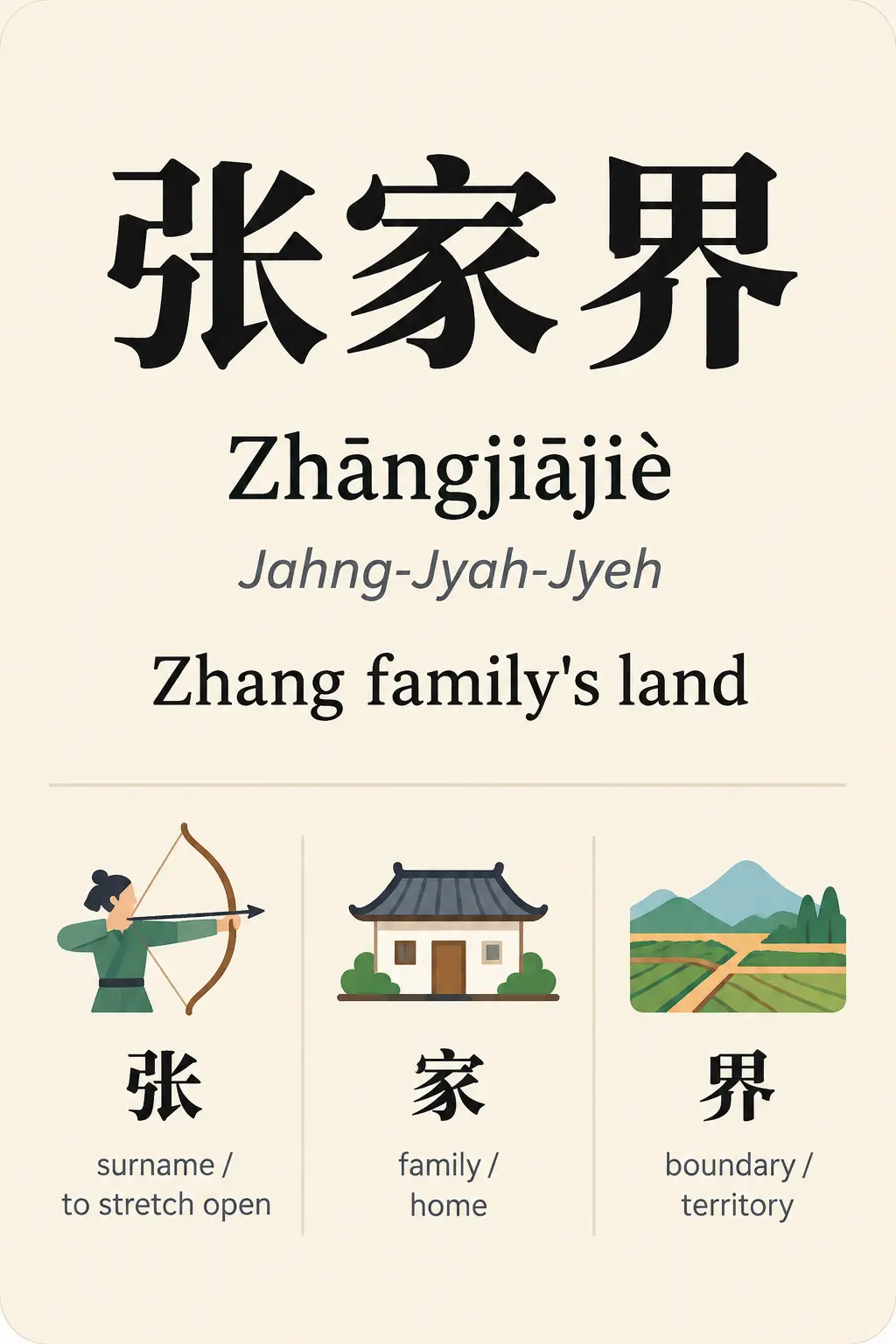
张家界 (pinyin: Zhāngjiājiè — say it “Jahng-Jyah-Jyeh” and locals will understand).
Break it down, and Zhangjiajie in Chinese characters becomes far easier to remember:
| Character | Pinyin | Meaning | Memory hook |
|---|---|---|---|
| 张 | Zhāng | a surname; also “to open, to spread” | left “弓” (bow) + right “长” (long) — a drawn bow |
| 家 | Jiā | home, family | a roof (宀) over a pig (豕) — home is where the livestock is |
| 界 | Jiè | boundary, border | left “田” (field) + right “介” — a field’s dividing line |
That’s Zhangjiajie in Chinese: three characters, one place. Want to write it by hand? Stroke order: 张 (11 strokes), 家 (10 strokes), 界 (9 strokes). You don’t need to produce them — just recognize 张家界 when you see it on a sign.
Zhangjiajie Pronunciation: Don’t Make All Three Syllables Sound the Same
Let’s talk about the Zhangjiajie pronunciation properly. The most popular rough spelling is “Jahng-Jyah-Jyeh.” It works in a pinch. But here’s the problem: it flattens all three initials into one “j” sound. Native speakers don’t. There are two different sounds hiding in there.
Listen first — here’s how a native speaker says it (5 seconds):
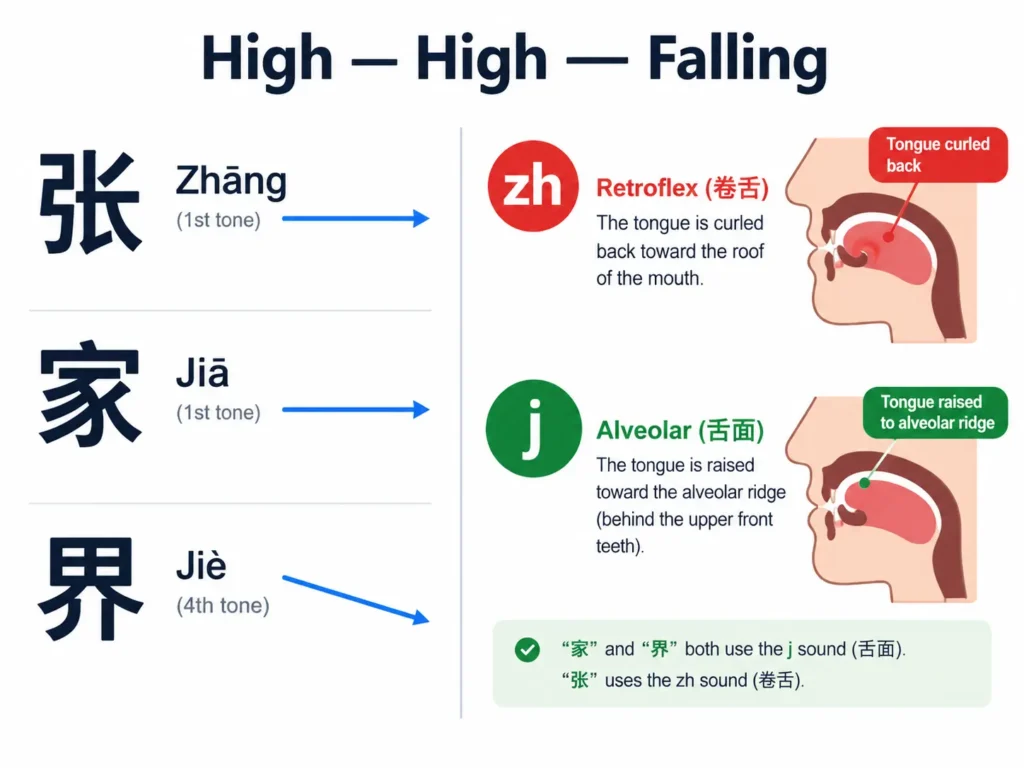
- 张 (Zhāng) — the “zh” is retroflex: curl your tongue tip up against the roof of your mouth, more “rolled” than the “j” in “judge.” First tone, high and flat.
- 家 (Jiā) — the “j” is a palatal sound: tongue tip down against the lower teeth, no curl. First tone, high and flat.
- 界 (Jiè) — same “j” as 家, with a vowel like “yeah” but short. Fourth tone, dropping.
The whole word runs high — high — falling. For the Zhangjiajie pronunciation in English, “Jahng-Jyah-Jyeh” is the closest fit (standard Mandarin IPA: [tʂɑŋ tɕi̯a tɕiɛ]).
The single biggest Zhangjiajie pronunciation mistake? Turning the “zh” of 张 into the same “j” as 家 and 界. Say all three as “j” and you’ll still be understood — but nail the “zh” and the driver reacts a half-beat faster. If you want the Zhangjiajie pronunciation to stick, think of 张 as “jahng” (tongue curled) and the other two as “jyah-jyeh” (tongue flat). Two different sounds, one word.
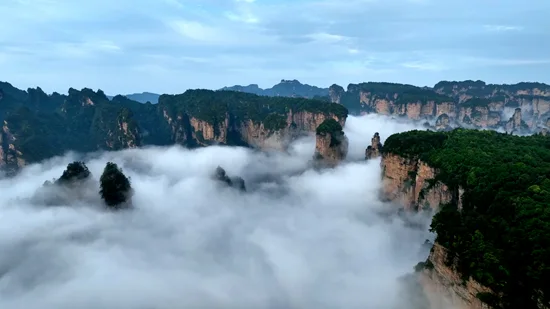
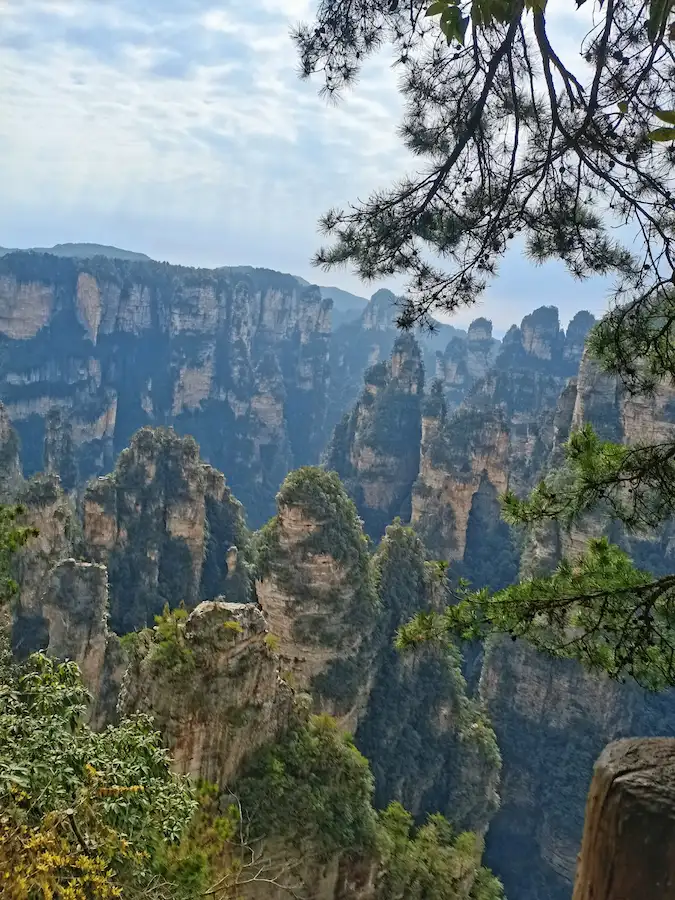
If you’re asking how to pronounce Zhangjiajie in one line: curl the first syllable, flatten the last two, and let the tone fall at the end. And if how to pronounce Zhangjiajie still escapes you on the spot, just say “Avatar Mountain” (the floating one from the movie). Plenty of locals know exactly where you mean.
What Does Zhangjiajie Mean?
Put the three characters together and Zhangjiajie meaning is simply: the Zhang family’s land.
“界” in this corner of western Hunan often means “family territory” or “mountain border.” So 张家界 = the settlement of the Zhang clan. As for who “Zhang” was, there are two versions:
One (with local gazetteer records behind it): In the Ming dynasty’s Hongzhi era, commander Zhang Wancong was rewarded for his military service with this stretch of forested mountain as a fief. He moved his family up to work the land. By the Chongzhen era, his sixth-generation descendant was granted an official post and set up an office here, making it hereditary Zhang clan territory — and the name stuck. The family flourished there for seventeen generations.
The other (folk legend): the Han dynasty strategist Zhang Liang spent his later years in hiding here and was buried at Shuizhuan Simen, so it was called Zhangjiajie long ago.
The modern timeline is shorter: a state forest farm in 1958, the first National Forest Park in 1982, and in 1994 the State Council renamed Dayong city as Zhangjiajie city. That’s the Zhangjiajie you hear today.
Five Mandarin Phrases You’ll Actually Use
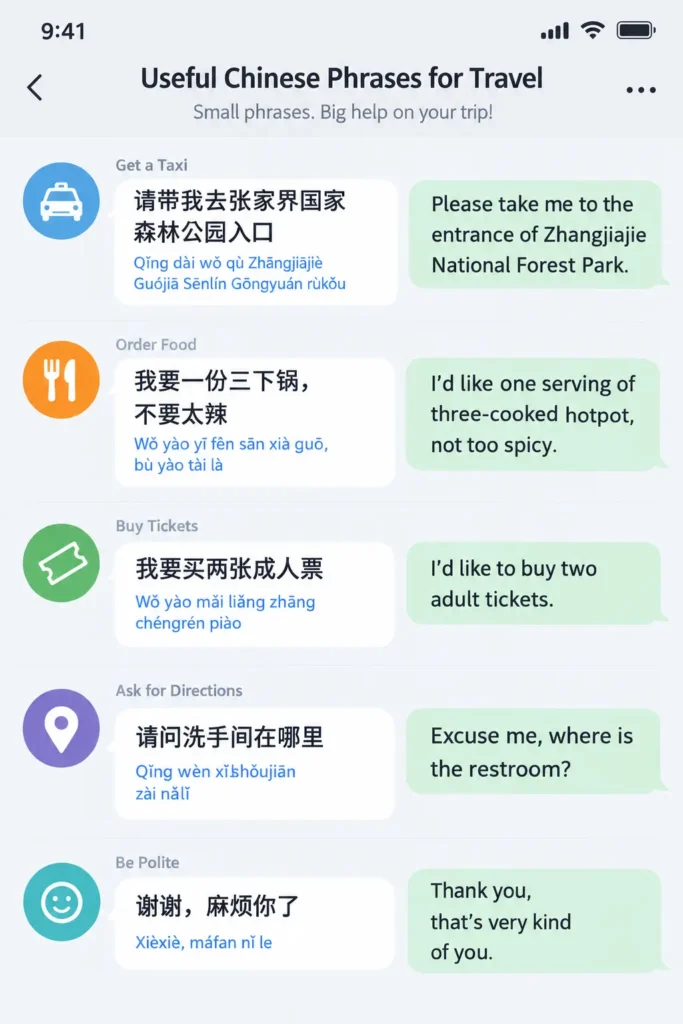
More useful than the name is what to say once you’re here. Show these on your phone, or read the pinyin out loud:
Taxi / Didi
- 请带我去张家界国家森林公园入口。(Qǐng dài wǒ qù Zhāngjiājiè Guójiā Sēnlín Gōngyuán rùkǒu.) — Take me to the entrance of Zhangjiajie National Forest Park.
- 请打表,谢谢。(Qǐng dǎbiǎo, xièxie.) — Please use the meter, thanks.
Ordering Food
- 我要一份三下锅,不要太辣。(Wǒ yào yí fèn sānxiàguō, búyào tài là.) — I’d like a Sanxiaguo, not too spicy.
- 请问有不辣的菜吗?(Qǐngwèn yǒu búlà de cài ma?) — Do you have any non-spicy dishes?
Buying Tickets
- 我要买两张成人票。(Wǒ yào mǎi liǎng zhāng chéngrén piào.) — Two adult tickets, please.
- 请问天门山 A 线索道还有票吗?(Qǐngwèn Tiānmén Shān A xiàn suǒdào hái yǒu piào ma?) — Any tickets left for Tianmen Mountain cableway Route A?
Asking Directions
- 请问索道站怎么走?(Qǐngwèn suǒdào zhàn zěnme zǒu?) — How do I get to the cableway station?
- 请问洗手间在哪里?(Qǐngwèn xǐshǒujiān zài nǎlǐ?) — Where’s the restroom?
Being Polite
- 谢谢,麻烦你了。(Xièxie, máfan nǐ le.) — Thanks, I appreciate it.
- 没关系 / 不客气。(Méi guānxi / Bú kèqi.) — It’s okay / You’re welcome.
Zhangjiajie Attraction Names in Chinese (Screenshot This)
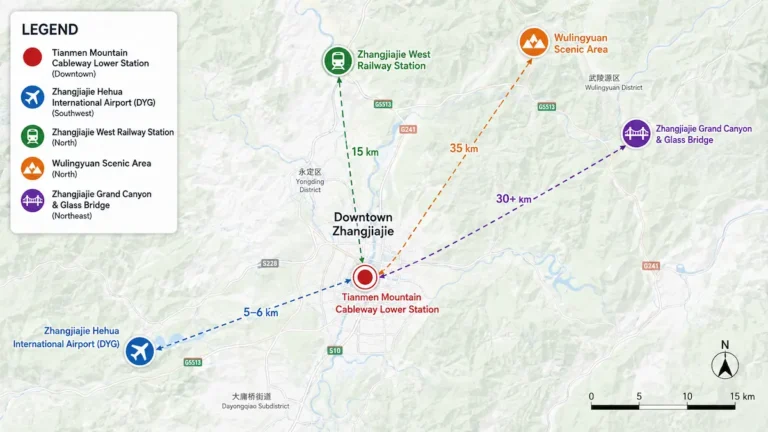
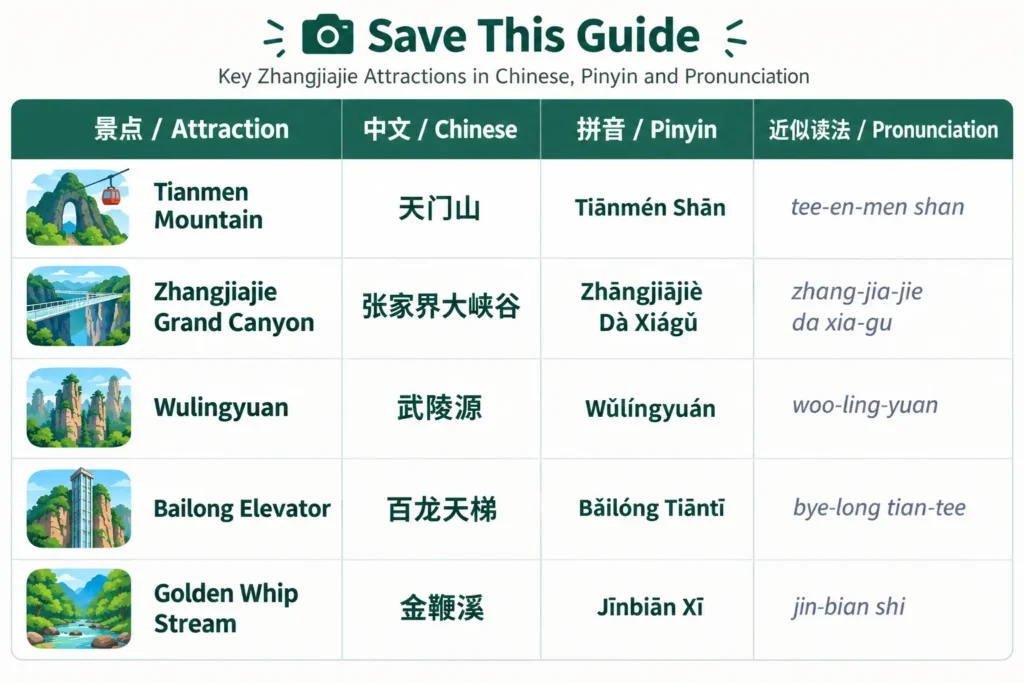
Here’s how to say the main sights — including tianmen mountain in chinese and zhangjiajie grand canyon in chinese:
| Attraction | Chinese | Pinyin | Rough reading |
|---|---|---|---|
| Zhangjiajie National Forest Park | 张家界国家森林公园 | Zhāngjiājiè Guójiā Sēnlín Gōngyuán | Jahng-jyah-jyeh Gwoh-jyah Sun-lin Gong-ywan |
| Wulingyuan | 武陵源 | Wǔlíngyuán | Woo-ling-ywan |
| Tianmen Mountain | 天门山 | Tiānmén Shān | Tyen-men Shan |
| Zhangjiajie Grand Canyon | 张家界大峡谷 | Zhāngjiājiè Dà Xiágǔ | Jahng-jyah-jyeh Dah Shyah-goo |
| Glass Bridge | 玻璃桥 | Bōli Qiáo | Bwo-lee Chyao |
| Bailong Elevator | 百龙天梯 | Bǎilóng Tiāntī | Bye-long Tyen-tee |
| Golden Whip Stream | 金鞭溪 | Jīnbiān Xī | Jin-byen Shee |
| Yuanjiajie | 袁家界 | Yuánjiājiè | Ywan-jyah-jyeh |
| Tianzi Mountain | 天子山 | Tiānzǐ Shān | Tyen-zih Shan |
| Yellow Dragon Cave | 黄龙洞 | Huánglóng Dòng | Hwahng-long Dong |
| Baofeng Lake | 宝峰湖 | Bǎofēng Hú | Bow-fung Hoo |
| Ten-Mile Gallery | 十里画廊 | Shílǐ Huàláng | Shr-lee Hwah-lahng |
Three Traps I’ve Watched Travelers Fall Into
No signal inside caves and deep valleys. Places like Yellow Dragon Cave — and the deep gorges of the forest park — often have zero cell signal. Mobile payment and online translation both die. The sign inside says it plainly: “洞内无信号,请保管好随身物品 / No Signal Inside.” Pay what you need, look up what you need, screenshot what you need — before you go in.
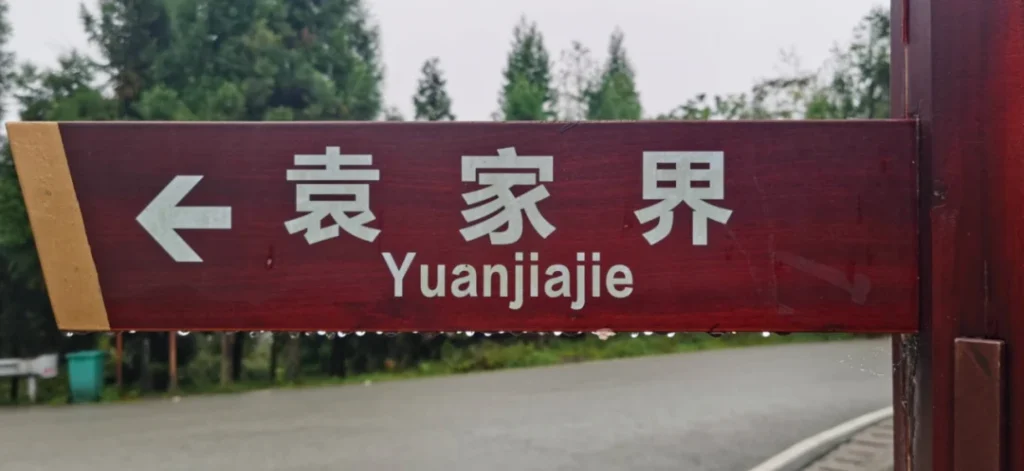
Road signs don’t match each other. The same landmark gets translated two ways: Yuanjiajie becomes both “Yuanjiajie” and “Yuanjia Boundary,” and Bailong Elevator shows up as “Bailong Elevator” and “Hundred Dragons Elevator.” Don’t trust the English signs to be consistent — go by the pinyin and the characters.
Phonetic spelling only gets you so far. “Jahng-Jyah-Jyeh” will probably be understood. But try asking for directions to Yuanjiajie with it, and you might get a blank stare. When you need a specific place, show the characters and pinyin instead of speaking. That’s the whole point of knowing Zhangjiajie in Chinese — the written form works where your accent fails.
FAQ
What is Zhangjiajie in Chinese?
It’s 张家界 — pinyin Zhāngjiājiè, meaning “the Zhang family’s land.”
What is Zhangjiajie called in English?
There’s no official English name — it’s just the pinyin “Zhangjiajie” (张家界).
How do you pronounce Zhangjiajie?
“Jahng-Jyah-Jyeh” — but curl the “zh” of 张 and keep 家 and 界 flat, with tones running “high — high — falling.”
What does “界” mean in the name?
Boundary or territory; locals here use it for a family’s land.
When should I avoid Zhangjiajie?
The language challenge is year-round, but holidays and summer holidays are the most crowded. Check the site’s weather and best-time pages for specifics.
Your Zhangjiajie Cheat Sheet
Screenshot this and you’re covered:
- Name: 张家界 (pinyin Zhāngjiājiè)
- Say it: Jahng-Jyah-Jyeh — “high, high, falling”
- Ask for help: 请带我去张家界国家森林公园入口。(Qǐng dài wǒ qù Zhāngjiājiè Guójiā Sēnlín Gōngyuán rùkǒu.)
- Order food: 我要一份三下锅,不要太辣。(Wǒ yào yí fèn sānxiàguō, búyào tài là.)
- Buy tickets: 我要买两张成人票。(Wǒ yào mǎi liǎng zhāng chéngrén piào.)
- Say thanks: 谢谢,麻烦你了。(Xièxie, máfan nǐ le.)
Learn to write 张家界, learn to say it without flinching, keep six phrases in your pocket — and let the scenery do the rest. Stand at the mouth of Tianmen Mountain or below the floating peaks of Yuanjiajie and say it right just once. You’ll know the trip was worth it.
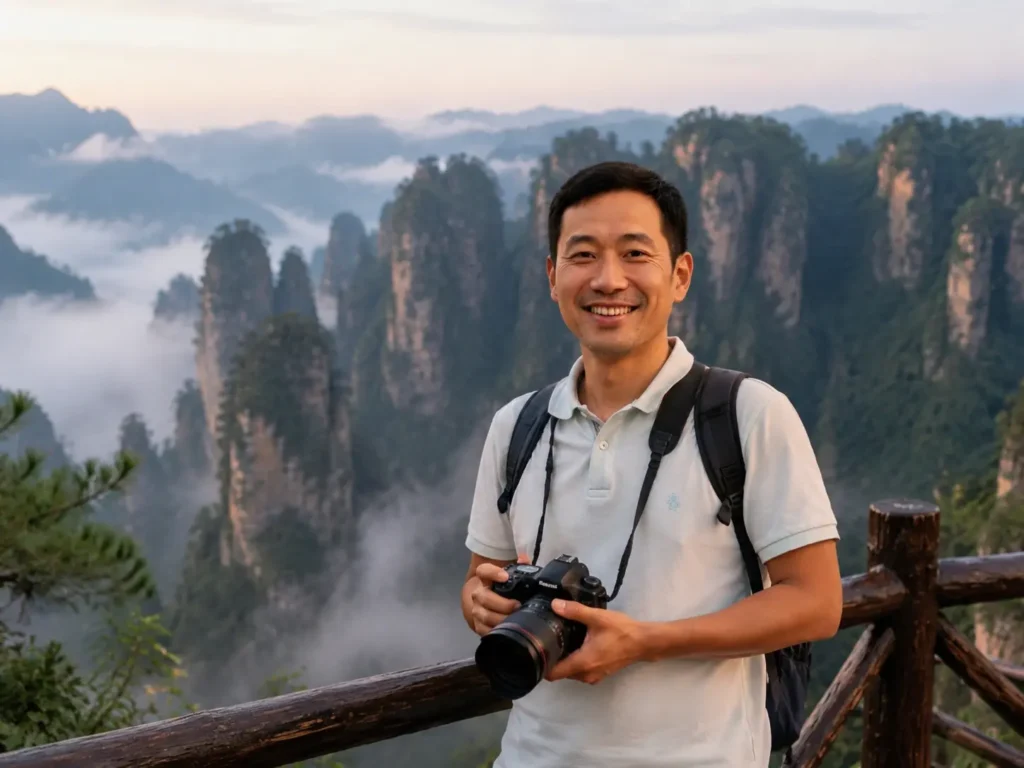
Hi, I'm Ke Ping — let me plan your Zhangjiajie trip
Certified China Travel Specialist · Certificate details
Instead of spending hours piecing everything together, I'll build the perfect itinerary for you — tickets, transport, and the spots most tourists miss.
📋 Plan My Zhangjiajie Trip