Zhangjiajie Itinerary 3 Days (2026): Tianmen First, Then the Avatar Mountains — A Smarter Route
You’ve seen the photos. Towering sandstone pillars wrapped in mist. A glass walkway bolted to a vertical cliff. A mountain with a hole punched clean through it. This zhangjiajie itinerary 3 days is built for first-timers who want all of that—without wasting a single morning on bad logistics.
Wondering how many days in Zhangjiajie you actually need? Three is the sweet spot. Two days leaves you rushing. Four or five can work if you want a slower pace, but three days hits every headliner while keeping the energy up. If you’re searching for a zhangjiajie 3 day itinerary that actually makes sense on the ground, you’ve found it. Every detail in this zhangjiajie itinerary 3 days has been tested and adjusted for 2026—ticket prices, bus routes, opening hours, the works.
- Your Zhangjiajie Itinerary 3 Days: At a Glance
- Before You Go — 2026 Tickets, Transport & Practical Tips
- Day 1 — Tianmen Mountain: Cable Cars, Glass Walks & Heaven's Gate
- Day 2 — Zhangjiajie National Forest Park: The Avatar Mountains
- Day 3 — Golden Whip Stream & A Smooth Departure
- Prefer a Guided Zhangjiajie 3 Day Tour?
- Short on Time? Try a 2-Day Zhangjiajie Plan Instead
- Have More Days? What a 4-Day Zhangjiajie Itinerary Looks Like
- Quick Answers for Your 3 Days in Zhangjiajie
Your Zhangjiajie Itinerary 3 Days: At a Glance
Most 3-day Zhangjiajie itineraries start with the National Forest Park. We do the opposite — and there’s a reason. Starting with Tianmen Mountain lets you acclimate on a compact half-day mountain before diving into the massive Forest Park on Day 2. It’s the difference between easing into cold water and jumping in headfirst.
📥 Want the 2026 Zhangjiajie Route PDF?
Get instant access to our 3-page survival guide, crowd-dodging route logic, and local payment hacks.
Here’s what your 3 days in Zhangjiajie looks like, stripped down to the skeleton:
- Day 1 — Tianmen Mountain: The world’s longest cable car, cliffside glass walkways, and Heaven’s Gate. End the day at a neon-lit night market.
- Day 2 — Zhangjiajie National Forest Park: The Avatar mountains, the world’s tallest outdoor elevator, and the imperial rock garden of Tianzi Mountain.
- Day 3 — Golden Whip Stream & Departure: A flat, shady canyon walk through the valley floor. Monkeys, a legendary creek, and a clean exit by early afternoon.
This order isn’t random. Day 1 acclimates you with a half-day mountain (Tianmen is compact). Day 2 throws you into the deep end with the park’s biggest, most demanding section. Day 3 cools things down with an easy valley walk that ends near your exit route. It’s the same logic any good zhangjiajie 3 day itinerary follows: build up, peak hard, cool down. Stick to this zhangjiajie itinerary 3 days and you’ll leave with full memory cards and zero regrets about mis-spent time.
Before You Go — 2026 Tickets, Transport & Practical Tips
Book These Tickets in Advance
Every major scenic area in Zhangjiajie now uses real-name timed reservations. During peak season (May–October and all Chinese public holidays), tickets sell out days ahead. Book at least 3 days early.
Here’s what you’ll pay for the core tickets on this itinerary:
- Wulingyuan Core Scenic Area (Zhangjiajie National Forest Park) — 228 RMB (approx. 33 USD), includes entry, free shuttle buses inside the park, and 3 RMB accident insurance. Valid for 4 consecutive days.
- Tianmen Mountain — 288 RMB (approx. 41 USD), includes the main cableway, express chairlift, shuttle bus, and insurance. Choose Route A (cable car up, bus down) when booking. It’s the best direction for first-timers.
- Bailong Elevator (one way up) — ¥65 (approx. USD 9).
- Tianzi Mountain Cable Car (one way down) — ¥72 (approx. USD 10).
- Ten-Mile Gallery Mini Train (one way, optional) — ¥38 (approx. USD 5.50).
Money-saving tip: If you plan to ride the Bailong Elevator, Tianzi Mountain Cable Car, and one more ropeway, buy the “Three Ropeways + One Elevator” combo ticket on the official mini-program. It shaves off a few dozen yuan versus buying separately.
How to book: The official channel is the WeChat mini-program “张家界一机游” (scan the QR code on the park’s website or search for it inside WeChat). The park’s updated official ticketing site is hnzjj.com. Trip.com also sells tickets, usually at a small markup. Bring your passport — you’ll need it at every gate.
Park hours: Gates open at 06:30 and close at 17:00. Shuttle buses run until 19:00 (fewer after 18:30). Cable cars and the elevator operate 06:30–17:30, with last ticket sales at 17:00. If you’re entering through the East Gate (Wulingyuan), you must pre-book the “East Gate Line B” slot on the official mini-program.
Getting Here & Getting Around
By air: Zhangjiajie Hehua International Airport (DYG) has direct flights from most major Chinese cities. A taxi from the airport to Wulingyuan East Gate takes 40–50 minutes (¥100–120 / USD 14–17). An airport shuttle bus to Wulingyuan costs around ¥20 (USD 3) and departs roughly hourly. For full logistics, check our Zhangjiajie Airport & Transportation Guide.
By high-speed train: Changsha to Zhangjiajie West Station takes about 2.5 hours (¥135–166 / USD 19–24 one way). From Zhangjiajie West Station, a bus to Wulingyuan East Gate costs ¥13 (USD 2) and takes 40 minutes. Taxi is around 40 minutes, ¥80–100 (USD 11–14). For all routes into the region, see our how to get to Zhangjiajie page.
Getting between scenic areas:
- Wulingyuan East Gate → Forest Park South Gate: Minibus from the East Gate entrance, ¥8 (USD 1), 25 minutes.
- Wulingyuan East Gate → Tianmen Mountain Cable Car Station: Taxi or Didi, about 40 minutes, ¥80–100 (USD 11–14).
Where to Stay
Book one place and stay put: a hotel or guesthouse within walking distance of Wulingyuan East Gate (also called Biaozhimen / 标志门). This zhangjiajie itinerary 3 days is designed so you never need to switch hotels. Day 1’s Tianmen Mountain is a 40-minute taxi from here. Day 2’s park entrance is a 5-minute walk. Day 3’s departure route brings you right back to this neighborhood. The area around East Gate is dense with restaurants, convenience stores, ATMs, and foot massage parlors — exactly what you want after a 20,000-step day. Browse our where to stay in Zhangjiajie guide for recommended hotels near the East Gate.
What to Pack
- Hiking shoes with grip. Not sneakers. The stone paths and steps get slippery when wet, and they get wet often.
- A thin rain jacket. More useful than an umbrella. Mountain weather flips in minutes. A sudden downpour right after sunshine is just how it works here.
- Power bank. You’ll drain your phone battery on photos and navigation by early afternoon.
- A light layer. Even in summer, the mountain tops and early mornings run cool.
- Your passport. Required for ticket collection and park entry.
- Cash. ¥2,000–3,000 (USD 286–429) in Chinese yuan. Most places use WeChat Pay or Alipay, but foreign cards don’t link to them easily. Larger hotels and ticket offices usually accept Visa/Mastercard. Street vendors, small restaurants, and rural stalls are cash-only for foreign travelers.
Day 1 — Tianmen Mountain: Cable Cars, Glass Walks & Heaven’s Gate
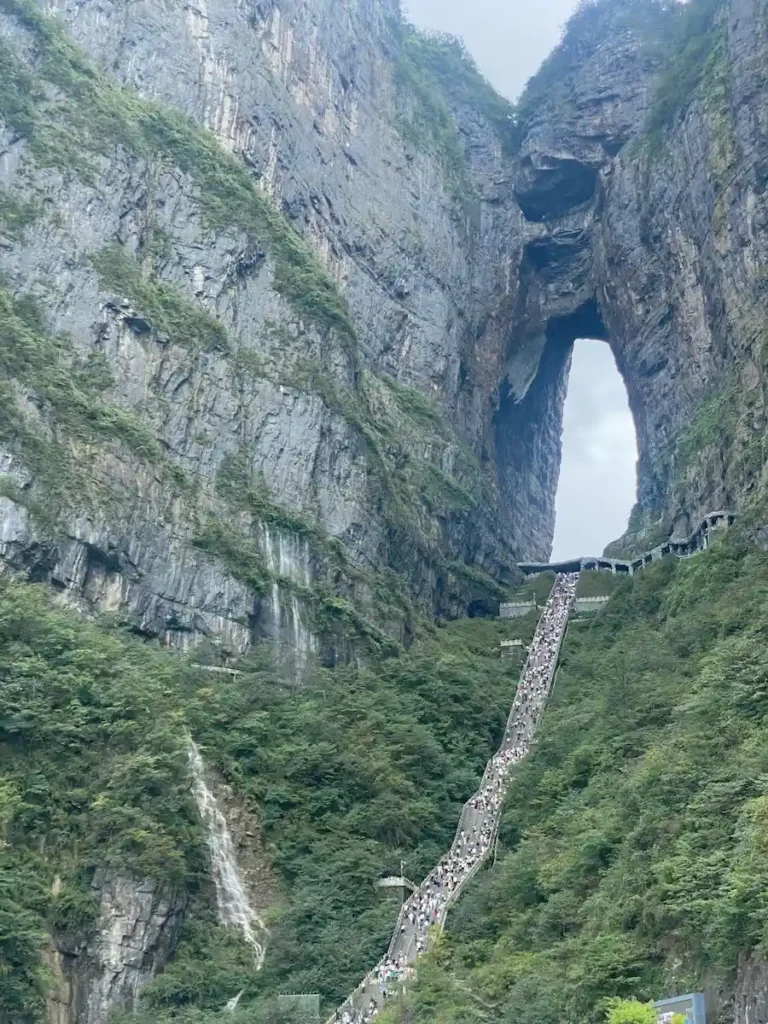
Tianmen Mountain sits right at the edge of Zhangjiajie city. It’s compact, self-contained, and the perfect opening act. You’ll be back at your hotel by late afternoon with energy left for the evening.
Morning: Ride the World’s Longest Cable Car
Take a taxi from Wulingyuan to the Tianmen Mountain cable car station downtown (about 40 minutes). Make sure you booked Route A — this is the cable-car-up, bus-down direction and it’s the one you want.
The cable car is 7,455 meters long (4.6 miles). It takes 28 minutes. You start in the city and end at 1,500 meters above sea level, watching the urban grid shrink under fields, then forests, then clouds. By the time the gondola docks at the summit station, the city feels like a distant memory.
Late Morning: Walk the Glass Skywalk & Cliff Path
Take the West Line loop once you’re on top. It hits the highlights in one direction with no backtracking.
First stop: the Glass Skywalk. Sixty meters of transparent glass bolted to the outside of a cliff face. The drop below is 800 meters of empty air. You pay ¥5 (USD 0.70) for cloth shoe covers on-site. Some people shuffle sideways gripping the rock wall. Some walk it like a sidewalk. You’ll find out which one you are.
From there, follow the Ghost Valley Path — a walkway carved along a sheer cliff, said to be named after a sage who lived and studied here in ancient times. The clouds roll in without warning. One minute you’re looking at a valley; the next, you’re standing inside a cloud. Keep following the path to Tianmen Mountain Temple, a Buddhist temple perched on the summit with a quiet view over the whole range.
Afternoon: Through the Mountain to Heaven’s Gate
From the summit, ride the tunnel escalators down through the inside of the mountain — seven sections of indoor escalators (free, included in your ticket). It feels like descending through a sci-fi bunker. When the last section ends, you walk out and there it is: Heaven’s Gate.
The arch is 131.5 meters tall and 57 meters wide. It’s a natural hole through the mountain, and standing under it feels different than looking at photos. You can climb the 999 steps up to the arch (hard on the knees) or pay ¥32 (USD 4.50) for a smaller escalator that takes you right up. Either way, stand inside the arch for a minute and look out. It’s not subtle. It’s a hole in a mountain, and it’s spectacular.
The bus ride down from Heaven’s Gate takes you through 99 hairpin turns on the Tongtian Avenue — a road that squeezes 99 switchbacks into less than 11 kilometers. The drivers do this route dozens of times a day. Trust them.
Evening: 72 Wonder Towers & Your First Local Meal
Back at your hotel by mid-afternoon. Rest up, then head to 72 Wonder Towers (七十二奇楼) after dark — a multi-story night complex built in traditional Tujia architectural style, packed with live performances, interactive street shows, and food stalls. Entry is cheaper before 4pm, but the place truly comes alive at night.
Hungry? Try tujia sanxiaguo (土家三下锅) — smoked pork, tripe, and intestines simmered together in a clay pot. It’s the signature dish of the Zhangjiajie region. Tell them “wei la” (微辣, mild spicy) if you’re not ready for full Hunan fire. If that sounds intimidating, fried rice and steamed egg are available everywhere and always a safe bet.
Day 2 — Zhangjiajie National Forest Park: The Avatar Mountains
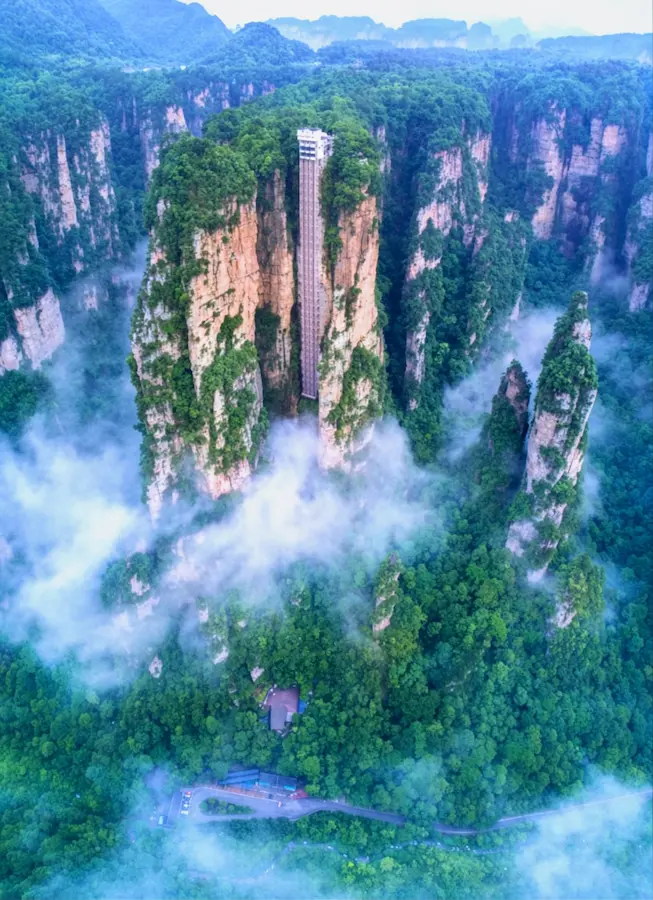
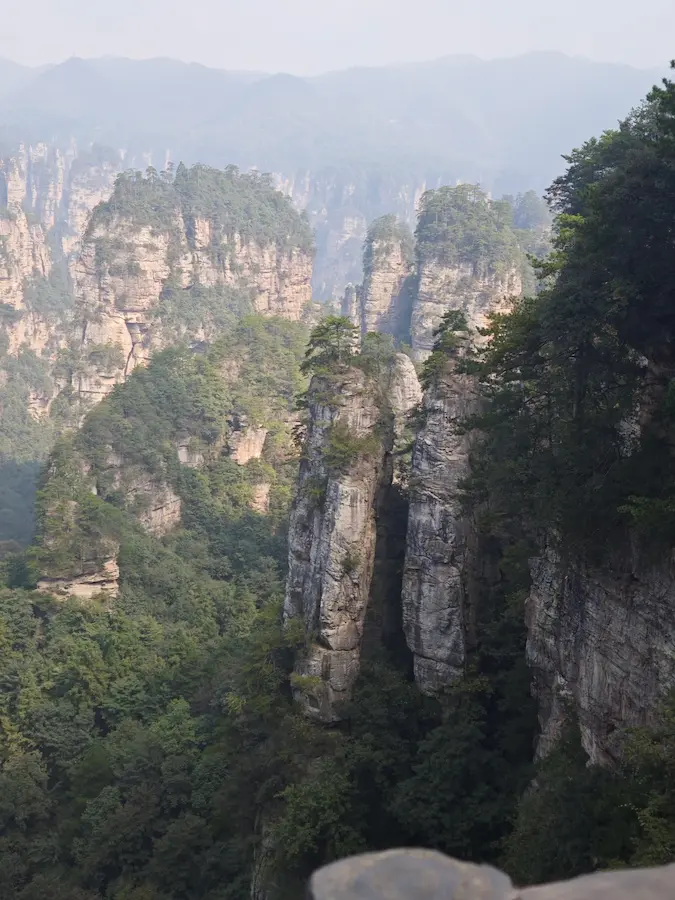
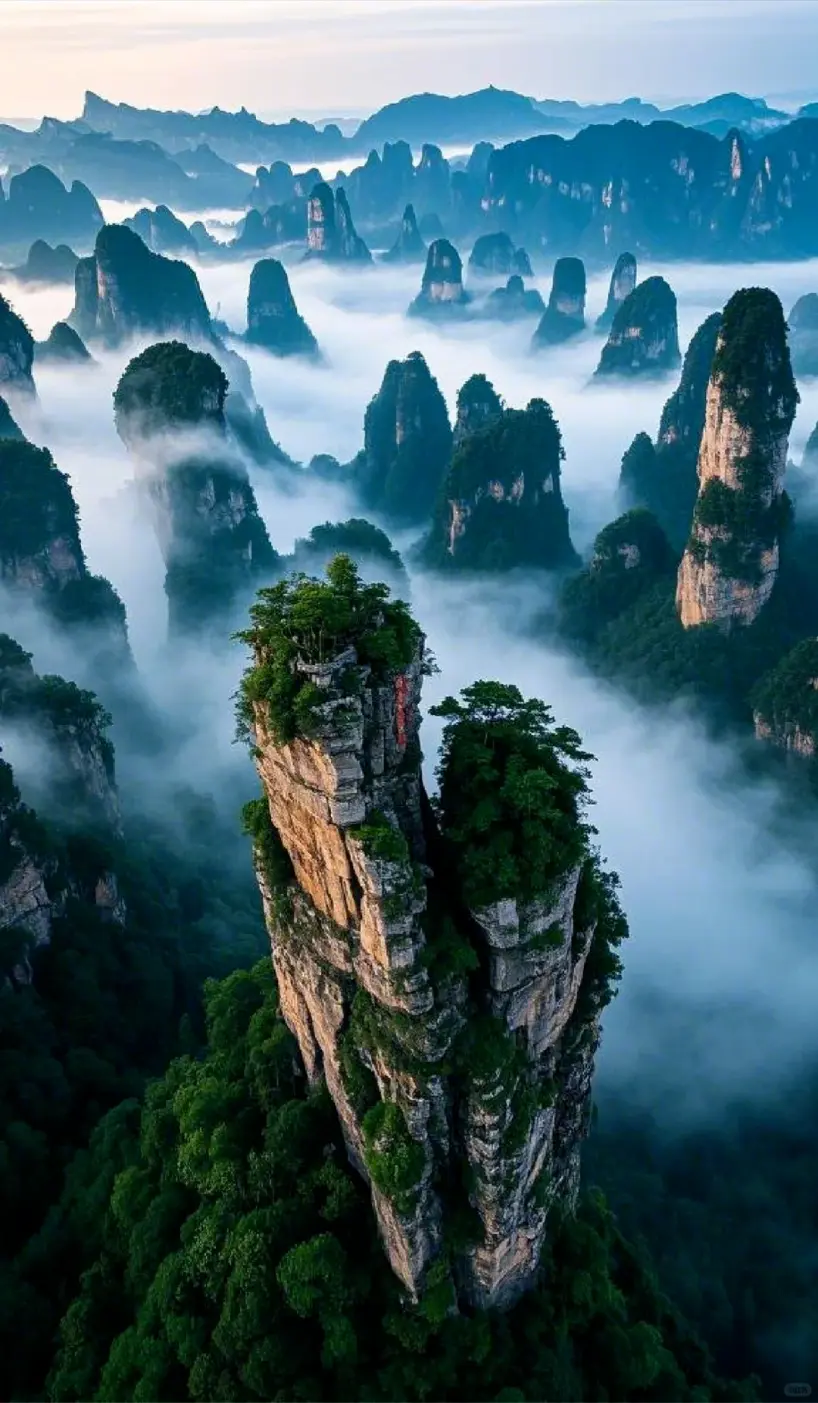
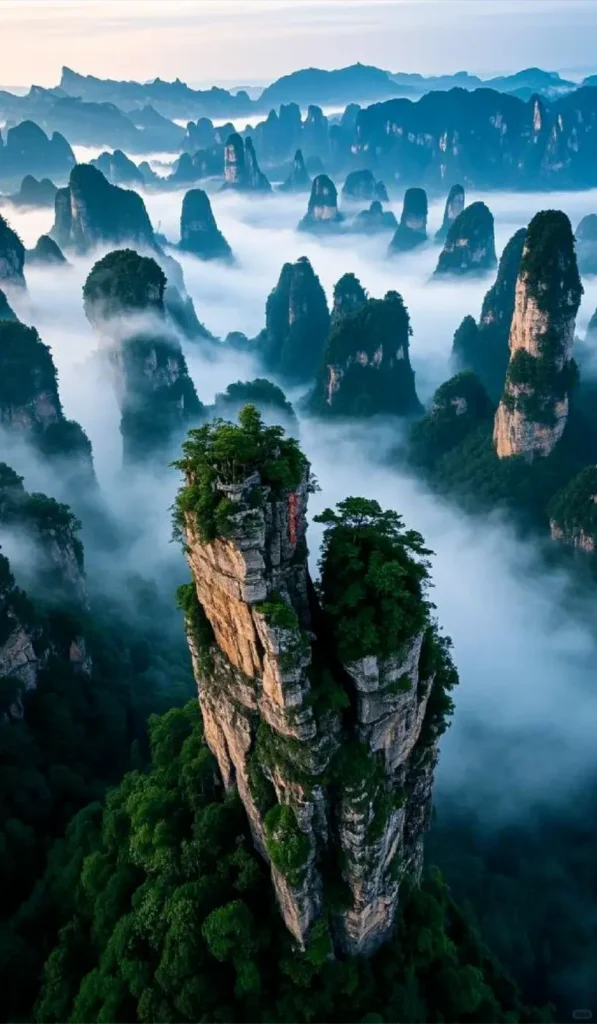
This is the big one. Zhangjiajie National Forest Park is where those quartz-sandstone pillars — over 3,000 of them — rise out of a subtropical valley like a stone forest designed by a surrealist. It’s also where things get crowded fast. The solution is simple: get there early.
Wake-up call: Aim to be at the East Gate by 07:00. You already booked “East Gate Line B” on the mini-program. Crowds swell sharply after 09:00. One early morning buys you two extra hours of quiet trails.
Early Start: The Bailong Elevator
Enter through the East Gate with your passport. Take a park shuttle bus (free, about 20 minutes) to the Bailong Elevator lower station.
This lift holds a Guinness World Record as the tallest outdoor elevator on Earth. Vertical rise: 335 meters. Running height: 326 meters. Speed: 5.25 meters per second. Time from bottom to top: 88 seconds.
The first half of the ride is inside a shaft drilled into the mountain. At the 154-meter mark, the elevator bursts out of the rock face and the glass panels reveal the full panorama — hundreds of sandstone pillars punching through morning mist. Don’t spend those last 30 seconds looking at your phone.
Late Morning: Yuanjiajie — Welcome to Pandora
Yuanjiajie is the crown jewel. Give yourself about 1.5 hours to walk the loop. Here’s what you’re here for:
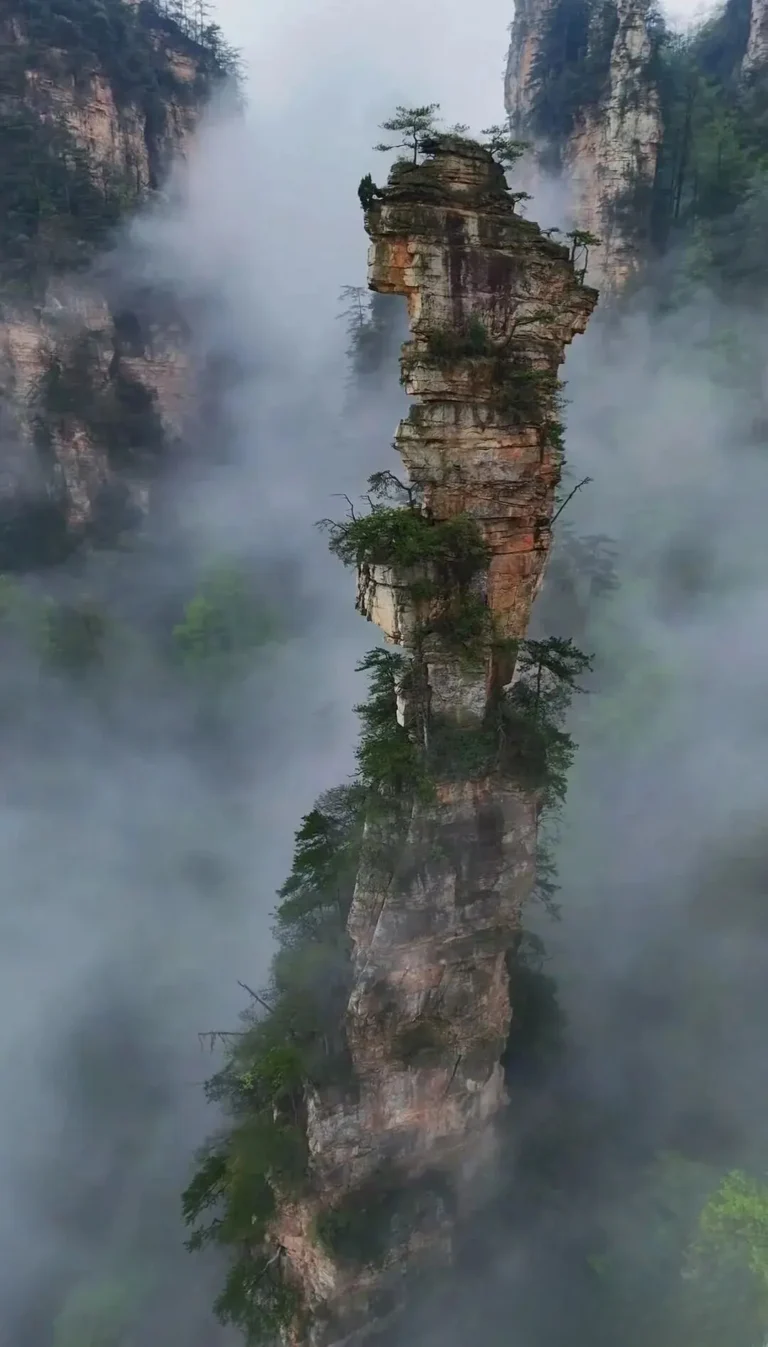
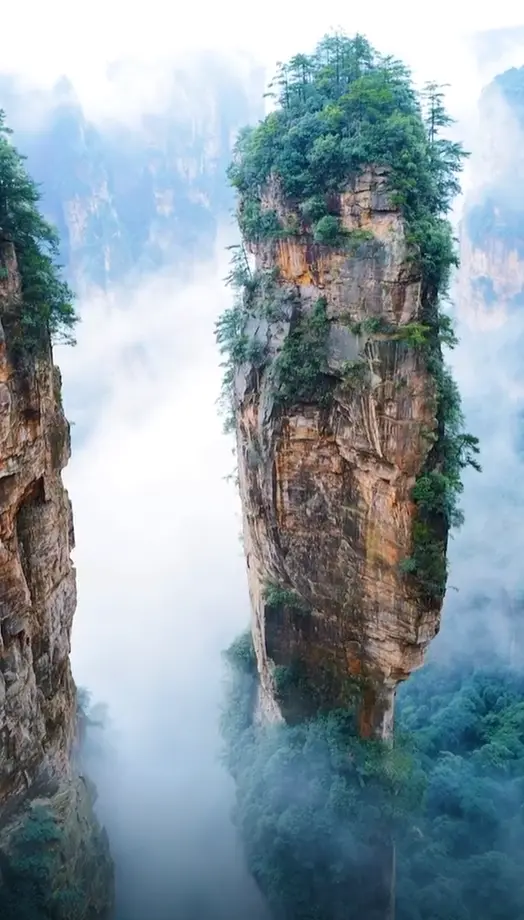
The Southern Sky Column (Qiankun Zhu). This is the pillar that inspired the floating “Hallelujah Mountains” in James Cameron’s Avatar. It doesn’t float in real life, but when morning fog swirls around its base and the top catches the light, your brain briefly disagrees. The park even labels it “Avatar Hallelujah Mountain” on English signs.
Enchanting Terrace (Mihun Tai). A viewing platform where hundreds of stone pillars fan out in front of you like a petrified army. The depth and scale mess with your sense of distance. Stare long enough and it starts feeling like the pillars are moving.
No. 1 Bridge Under Heaven. A natural rock bridge connecting two peaks over a deep chasm. It looks precarious. It isn’t, but it looks it.
Monkey alert: The macaques in Yuanjiajie are bold. They see plastic bags and assume food. They will approach. Do not feed them. Do not make eye contact. Keep bags zipped. They move on fast if there’s nothing to take.
Lunch options near the Yuanjiajie visitor center include a buffet (about ¥68 / USD 10 per person) and snack stalls. Packing your own food and finding a quiet viewpoint bench works better — lunch with a view of the Avatar mountains costs nothing extra.
Afternoon: Tianzi Mountain — The Imperial View
A 30-minute shuttle bus ride brings you to Tianzi Mountain. If Yuanjiajie is the blockbuster, Tianzi is the critic’s pick — denser, more elegant, less crowded.
Imperial Brush Peak (Yubi Feng) is the image you see on Chinese postage stamps and travel posters: several slender stone columns standing shoulder to shoulder like calligraphy brushes in a holder. Fairy Scattering Flowers is a rock formation nearby that — with some imagination — looks like a maiden holding a flower basket. You don’t need the backstory. The view from this ridge is complete on its own.
Walk through Helong Park and past Tianzi Pavilion. The entire platform offers a commanding view of the Wulingyuan range. A local saying goes: after seeing Tianzi Mountain, the world’s other mountains feel redundant. It’s exaggeration, but you’ll understand where it comes from.
Take the Tianzi Mountain Cable Car down (¥72 / USD 10, about 6 minutes). Stand on the right side of the cabin for the best views — deep gorges and endless pillar formations rolling past the window. A shuttle bus from the lower station brings you back to the East Gate. You’ll be out around 17:00.
Evening: Rest Your Legs, Eat Well
Walk back to your hotel. Then find food. Xibu Street near the East Gate is a pedestrian night market with Miao silver jewelry stalls and street snacks. If your legs are shot — and they probably are — foot massage parlors are everywhere in Wulingyuan. ¥60–100 (USD 9–14) buys you 45 minutes of recovery.
For dinner beyond sanxiaguo, try rock-ear fungus stewed with chicken (岩耳炖土鸡) — a mild, savory soup made with a fungus that grows on cliff faces. Or smoked pork stir-fried with fern cake (腊肉炒蕨粑), chewy and smoky and nothing like anything you’ve had before. If your stomach just wants familiarity, fried rice and steamed egg are on every menu.
Day 3 — Golden Whip Stream & A Smooth Departure
No more climbing. Day 3 of this zhangjiajie itinerary 3 days is a flat, shaded walk along a stream that cuts through the valley floor. It’s the comedown your legs deserve, and it’s timed so you can be on a train or plane by mid-afternoon.
Morning: Into the Canyon
Catch a minibus from the East Gate entrance to the Forest Park South Gate (¥8 / USD 1, 25 minutes). This is the oldest entrance to the park. Scan your passport and walk in.
Your starting point is Grand Oxygen Square — a wide lawn surrounded by ancient trees. The oxygen levels here are genuinely extreme. Take a few deep breaths. Your lungs will notice the difference.
From here, follow the creek downstream. Golden Whip Stream runs for 5.6 kilometers (about 3.5 miles) through the canyon, nearly flat the entire way. Walk time is roughly 2 to 2.5 hours at a relaxed pace. The path alternates between open sections where pillars tower overhead and dense forest tunnels where sunlight comes through in shafts.
Mid-Morning: Monkeys, Myths & Movie Sets
Golden Whip Rock looms next to the path — a 380-meter pillar with a warm brown-gold color in sunlight, said to resemble a giant whip thrust into the ground. You’ll also pass Split-Mountain Rock (a crack between two boulders with a folk legend attached — knowing the story is optional).
This section of the canyon was used as a filming location for the 1986 Chinese TV series Journey to the West, specifically the “Three Battles with the White Bone Demon” episode. If you’re traveling with a Chinese friend, they’ll probably recognize it immediately.
The macaques here are even more numerous than in Yuanjiajie. They line the path. They watch you. Keep snacks hidden. Keep plastic bags in your backpack. They know what a rustling wrapper sounds like.
Not up for another walk? You can swap this morning for the Zhangjiajie Grand Canyon Glass Bridge — the world’s longest and highest glass-bottom bridge, 430 meters across with a 300-meter drop underneath. It’s a completely different experience (more adrenaline, less nature), and it eats up about 3–4 hours. The Zhangjiajie Grand Canyon itself also has a scenic hike and boat ride after the bridge. If Instagram-worthy thrills matter more to you than a peaceful canyon stroll, the Glass Bridge delivers.
Midday: The Four-Water Crossing, Then Home
The hike ends at Four Waters Converge (水绕四门) — where four streams meet in a wide, rocky basin. It’s a quiet, unpretentious spot. Sit on a rock. Watch the water. Let your legs recover.
A shuttle bus takes you back to the East Gate (about 20 minutes). Grab your luggage from the hotel. From here:
- To Zhangjiajie West Station (high-speed rail): Walk to Wulingyuan Bus Station, take the shuttle — ¥13 (USD 2), 40 minutes.
- To the airport: Taxi in 40–50 minutes (¥100–120 / USD 14–17), or the airport shuttle bus — ¥20 (USD 3), departs hourly.
Prefer a Guided Zhangjiajie 3 Day Tour?
This itinerary works as a self-guided plan if you’re comfortable navigating with translation apps and offline maps. But if the thought of booking Chinese mini-programs, finding bus stops with zero English signage, and negotiating with taxi drivers sounds exhausting, a zhangjiajie 3 day tour with an English-speaking guide solves all of it.
Guided tours in Zhangjiajie typically run ¥600–800 per day (USD 86–114) for a private guide and driver. They handle tickets, route planning, meal stops, and the thousand small logistics that eat into your mental energy. For a zhangjiajie 3 day tour that covers roughly the same route outlined above, expect to pay in the range of ¥1,800–2,400 (USD 257–343) per person, depending on group size and season. Browse our Zhangjiajie tour itineraries for pre-built options or customizable private tours.
Short on Time? Try a 2-Day Zhangjiajie Plan Instead
Three days is ideal, but not everyone has three days. If you’re squeezing Zhangjiajie into a weekend, our 2-day Zhangjiajie itinerary condenses the highlights — you’ll drop Golden Whip Stream and run a tighter schedule, but you’ll still hit Tianmen Mountain and the Avatar peaks. It’s intense, but it works.
Have More Days? What a 4-Day Zhangjiajie Itinerary Looks Like
Got an extra day? A zhangjiajie itinerary 4 days lets you slow down and add one of these to the three-day plan above:
- Zhangjiajie Grand Canyon & Glass Bridge — the world’s longest glass-bottom bridge, plus a scenic canyon hike and a boat ride out. A full half-day.
- Baofeng Lake — a calm mountain lake surrounded by stone peaks. You board a wooden boat and float while a local singer performs traditional Tujia folk songs from a boat ahead.
- Yellow Dragon Cave — a vast karst cave system with underground rivers, giant stalactite halls, and boat rides through illuminated caverns. A good rainy-day option.
Adding any one of these turns your three-day sprint into a four-day journey with breathing room. If you want the Glass Bridge and the canyon walk without sacrificing Golden Whip Stream, a fourth day is the solution. For more ideas, explore our full list of things to do in Zhangjiajie.
Quick Answers for Your 3 Days in Zhangjiajie
Can I do this without speaking Chinese?
Yes, with effort. Park signage now includes English translations at major intersections. The challenge is restaurants, taxis, and bus stations — most staff speak zero English. Google Translate’s conversation mode (or a similar app) is your lifeline. If that sounds like too much friction, book an English-speaking guide. It changes the trip.
Is this itinerary okay for older travelers or young kids?
Most of the climbing is handled by cable cars and the elevator. But you’ll still log 15,000–20,000 steps a day. Older travelers without knee issues should manage fine. For toddlers, bring a lightweight stroller — some sections have stairs where you’ll need to carry it. Heaven’s Gate’s 999 steps are the one clear obstacle; pay the ¥32 escalator fee and skip them entirely.
What about the food? I don’t eat spicy.
Hunan cuisine is famously hot. But Wulingyuan and the city center are full of restaurants that serve non-spicy fried rice, steamed egg, stir-fried vegetables without chili, and plain noodle soups. Learn the phrase “bu yao lajiao” (不要辣椒, no chili) or show it on your phone. McDonald’s and KFC exist downtown as a last resort. But try a bowl of Hunan rice noodles at least once — they’re mild by default and genuinely good.
When is the best time to do this itinerary?
April through October is the window. Spring and autumn offer the most comfortable weather. Summer is greener but wetter — the upside is that post-rain clouds create the most stunning sea-of-clouds effects you’ll see all year. Winter brings snow but some cliff paths may close. Avoid the first week of May (Labor Day) and the first week of October (National Day) unless you enjoy sharing viewpoints with a thousand people. For a deeper seasonal breakdown, see our guide on the best time to visit Zhangjiajie.
Will it rain? What if it does?
Probably, especially in summer. Rain in Zhangjiajie comes fast and leaves fast. Wear your rain jacket, not an umbrella — the paths are narrow and you’ll need both hands free. The payback: right after a summer shower, your chances of catching a sea of clouds rolling through the pillars shoot way up. That sight alone is worth getting a little wet for.
Three rules to take with you: Wake up early — it’s the single biggest lever on your experience. Book everything on official channels before you arrive. Give the monkeys nothing. Follow these and this zhangjiajie itinerary 3 days will run like a clock.
You didn’t fly halfway around the world to sleep in and miss the mist clearing over the Avatar peaks at sunrise. Set the alarm for 6. Go.
Hi, I'm Ke Ping — let me plan your Zhangjiajie trip
Certified China Travel Specialist · Certificate details
Instead of spending hours piecing everything together, I'll build the perfect itinerary for you — tickets, transport, and secret spots.
📋 Plan My Zhangjiajie TripOR JUST WANT THE GUIDE?
Not ready to book? Get our free 3-page PDF guide
Instant access to 2026 route logic, crowd tips & payment hacks.